sales lead
A sales lead is a potential sales contact, individual or organization that expresses an interest in your goods or services. Leads are typically obtained through the referral of an existing customer or through a direct response to advertising or publicity. A company's marketing department is typically responsible for lead generation.
Pursuing and closing leads normally falls to the company's sales department. For example, an IT vendor or channel partner promotes its offerings at an industry trade show, hoping to attract the attention of qualified buyers attending the exhibit. Each inquiry for more vendor or partner information counts as a lead, which might subsequently develop into a sale.
The information captured in a sales lead varies. It could consist of a person's name and email address, or it could provide a broader view of the potential buyer, including information on the potential buyer's role in her company and an anticipated purchasing time frame. A company's lead generation efforts and its approach to dealing with leads can significantly affect its success in the marketplace. To that end, most organizations try to establish effective practices, spanning the lead generation, qualification and distribution processes.
Sales lead generation sources
The process of acquiring sales leads begins with lead generation. Lead generation involves marketing-related activities, or lead generators. At a basic level, lead generation can be as simple as obtaining referrals from existing customers. Companies looking to quickly boost revenue, however, typically adopt other lead generation techniques. For example, they may purchase sales lead lists from a lead generation company that maintains a database of business and consumer leads. Such lists may be used to conduct direct mail marketing, email marketing or telemarketing campaigns, all of which are forms of direct marketing.
Companies may also host or participate in business-to-business (B2B) events to generate leads. Examples of such event marketing activities include trade shows, webinars and lunch-and-learn meetings. The arrival of digital marketing opened a number of additional lead generation tools. In contrast to direct marketing techniques, digital marketing approaches, such as inbound marketing, focus on appealing to sales leads through company-generated online content. Inbound marketing content can include blog posts, videos, infographics and white papers. When creating and publishing inbound marketing content, companies may adopt a Content marketing strategy to promote their brand.
Inbound marketing also encompasses mobile and social media marketing using online platforms such as Facebook, LinkedIn and Twitter.
Sales lead management process
Successful lead generation activities will generate sales leads of varying quality and urgency. To maximize the business potential of those leads, a company can develop a lead management process, sometimes referred to as lead-to-revenue management, which involves methods and systems for capturing, tracking and distributing leads to sales reps for closing.
Sales lead management focuses on the cultivation of individual leads, which populate a company's sales pipeline. The marketing department typically is responsible for lead scoring -- that is, evaluating and ranking leads according to where the potential buyer stands in the purchase funnel, or sales funnel. The sales funnel, also described as the buyer's journey or sales cycle, begins with the buyer's earliest awareness of a product or service and culminates in a sale.
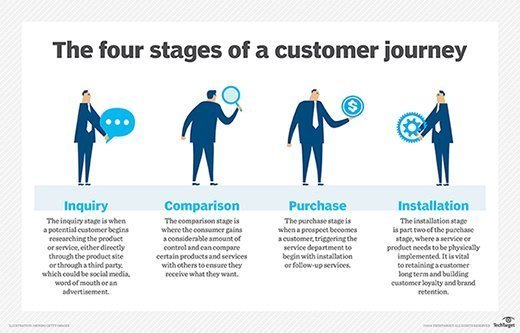
Types of leads
Along the entire path of a buyer's journey, the marketing team continues to score the leads, often in terms of points or a temperature scale -- hence cold or hot leads. Lead scoring can also be expressed in terms of lead qualification.
The following terms are used to describe different types of sales leads:
- Suspects: Sometimes called suspects, potential buyers at the top of the purchase funnel may express interest in a product or service when they visit a vendor's website to obtain general information. Getting suspects to move along the funnel toward a purchase is the task of lead nurturing. In lead nurturing, a marketer maintains a line of communication with the buyer, providing information as needed.
- Cold, warm and hot leads: Marketers and sales reps may classify leads as cold, warm or hot, depending on the prospective customer's level of interest in or readiness to purchase a product or service. For example, a prospect that has indicated immediate need for a service offering, a budget range for implementing the service and an implementation time frame, would likely be classified as a hot lead. By contrast, a warm lead may indicate a need for a product but no established budget or time frame in which to make the purchase. Some marketers and sales reps use the BANT system, which stands for budget, authority, need and time frame, to categorize leads as cold, warm or hot.
- Market-qualified lead: A marketing-qualified lead (MQL) is a prospective buyer that has shown interest in the product but isn't ready to make a purchase in the near term. Compared with sales-qualified leads (SQLs), which have indicated a high level of purchase intent, MQLs may require additional information about the product or service from the marketing team.
- Sales-qualified lead: An SQL demonstrates an immediate interest in buying and becomes a sales-ready prospect. At that point, the marketing team distributes the SQL to the sales team. In the IT channel, lead distribution may take place between a product vendor that generates and qualifies the lead and a channel partner, such as a value-added reseller (VAR).
Companies may automate the process of sales lead management, scoring and nurturing through customer relationship management (CRM) and marketing automation systems.